Expert plumbing for Beacon Hill's historic rowhouses, Federal-style brownstones, and condo buildings. Massachusetts licensed, fully insured, and deeply familiar with the unique plumbing demands of Boston's most storied neighborhood.
Call (888) 861-3658 — Available NowServing the historic heart of Boston with expertise, discretion, and deep local knowledge since day one.
Beacon Hill is unlike any other neighborhood in Boston — and plumbing work here demands an entirely different level of expertise than typical suburban service calls. The 19th-century Federal and Greek Revival rowhouses lining Acorn Street, Mount Vernon Street, and Chestnut Street were built between 1790 and 1870, and their plumbing systems have been layered and modified across multiple eras. When you call Beacon Hill Plumbing Pros, you're not getting a plumber who learned their trade in new construction subdivisions. You're getting a team that understands original cast-iron waste stacks, lead-wiped joints, hand-hammered copper, galvanized supply lines running through 8-inch masonry wall cavities, and the art of making modern repairs without destroying historic plaster or original millwork. We hold a full Massachusetts Plumber license and carry all required Boston building department permits, including those governed by the Boston Water and Sewer Commission (BWSC) — the regulatory authority for all water main connections and sewer lateral work in Boston proper.
The Beacon Hill housing stock presents a particular constellation of plumbing challenges that sets it apart even from other dense Boston neighborhoods. Many buildings contain shared waste stack systems that serve four to twenty individual condo units — a situation that demands careful diagnosis, neighbor coordination, and an understanding of condo association rules before any major work begins. Low-clearance cellar spaces beneath these rowhouses often contain original gravity-fed waste systems, early 20th-century hot water radiator piping, and supply lines that must be accessed with specialized compact tooling. When a pipe fails at 2 AM on a February night — and Boston's deep freeze winters have a way of finding every weak point in aging pipe systems — you need a plumber who can navigate Beacon Hill's famously narrow side streets, find parking in one of the most congested urban environments in New England, and get your heat back on without waking the entire building. That is exactly what we do, every day and every night.
We also maintain an ongoing familiarity with Massachusetts Historic Commission (MHC) guidelines and the Boston Landmarks Commission requirements that affect properties in Beacon Hill's designated historic district. While most interior plumbing work does not require historic review, any work involving exterior penetrations, vault space modifications, or visible utility runs on landmark-listed properties must be handled with sensitivity and proper documentation. Our team knows how to achieve modern plumbing performance — efficient hot water delivery, proper drain slope, code-compliant venting — while preserving the building fabric that makes Beacon Hill the irreplaceable neighborhood it is. Whether your home is a single-family Greek Revival on Louisburg Square, a four-unit condo conversion on Anderson Street, or a mid-century cooperative in the West Hill section near Massachusetts General Hospital, Beacon Hill Plumbing Pros is ready to serve you with the professionalism and discretion this community expects.
Burst pipes, sewer backups, and flooding emergencies in Beacon Hill's rowhouses and condo buildings. 24/7 rapid urban response — we know every alley and back street.
Learn More →Professional hydro-jetting and cable snaking for Beacon Hill's aging clay and cast-iron drain lines. Building stack cleaning for condo buildings and multi-unit rowhouses.
Learn More →Expert repair of all water heater types in Beacon Hill's space-constrained mechanical rooms and low-ceiling cellars. Fast diagnosis, same-day parts when possible.
Learn More →Tankless and high-efficiency water heater installation engineered for Beacon Hill's narrow utility spaces. Full BWSC permit handling and Boston building department approval.
Learn More →Cast-iron to PEX/copper repiping in historic Boston buildings. Minimal-invasive techniques to protect original plaster walls and period millwork throughout your home.
Learn More →Electronic acoustic and thermal imaging leak detection for slab leaks, hidden pipe leaks in masonry walls, and shared-wall condo situations on Beacon Hill.
Learn More →Bathroom remodels and repairs in Beacon Hill's Victorian-era bathrooms. Claw-foot tub plumbing, pedestal sinks, and modern fixture installation in historic spaces.
Learn More →Kitchen remodel plumbing for Beacon Hill townhouses and condos. Island sink venting, garbage disposal installation, and pot-filler connections in upgraded kitchens.
Learn More →Trenchless sewer lining and traditional excavation for Beacon Hill's aging clay and cast-iron lateral sewer lines. Full BWSC permit process managed for you.
Learn More →BWSC water main connections and lead service pipe replacement for pre-1988 Beacon Hill buildings. Coordination with Boston Water and Sewer Commission inspectors.
Learn More →Repair of antique chain-pull and vintage Boston toilets. Modern low-flow installation for condo water conservation requirements. Wax ring and flange repair.
Learn More →Whole-house filtration and under-sink systems for Boston's MWRA chloramine-treated water supply. Ideal for Beacon Hill condos and historic residences.
Learn More →We're not a suburban plumbing company that happens to take calls in the city. We are an urban Boston specialist team built for the specific demands of historic neighborhood plumbing.
Working in Beacon Hill's 19th-century rowhouses requires a fundamentally different skill set than standard plumbing work. When you peel back a section of wall in a building constructed in 1835, you may encounter lead-wiped lead joints on cast-iron drains, hand-packed oakum seals on hub-and-spigot pipe sections, early 20th-century galvanized steel supply lines with decades of mineral scale, and subfloor heating pipes from long-removed steam radiator systems. Our plumbers have trained specifically for this environment. We know how to identify which sections of aging cast iron are still serviceable versus which have reached the end of their structural integrity. We understand how to create effective transitions from original cast-iron drain stacks to modern PVC or ABS without introducing failure points. We are skilled at routing new copper or PEX supply lines through Beacon Hill's notoriously tight wall cavities — some only 3 to 4 inches wide within solid masonry — using flexible reaming tools and endoscopic cameras to thread new lines without major demolition. Our goal is always to preserve as much of the original building fabric as possible while delivering a repair or installation that will last for decades to come. We have worked in dozens of Beacon Hill addresses and understand that every block — Pinckney, Revere, Myrtle, Hancock — has its own era of construction and its own quirks.
The overwhelming majority of Beacon Hill's housing stock has been converted to condominium ownership over the past 40 years, and this creates a specific set of plumbing service challenges that our team is fully prepared to handle. When a drain line serves multiple units on a shared stack — as is almost universal in Beacon Hill's vertically-divided rowhouses — any major repair work requires proper notification of the condo association, coordination with neighbors above and below the affected unit, and a clear work plan that minimizes disruption. We have extensive experience reviewing condo master deeds and trust documents to determine exactly which portions of a building's plumbing system are the responsibility of the condo association versus individual unit owners. This matters enormously when deciding who authorizes the work and whose insurance is involved. We maintain professional relationships with many of the property management companies that oversee Beacon Hill condominium associations, and we understand how to move quickly through their approval processes when an emergency demands urgent action. For major planned work — such as a full stack re-lining or a water main replacement — we prepare clear written scopes of work that condo boards can present to their owners at association meetings. This professionalism and transparency is what keeps Beacon Hill property managers calling us first.
Getting plumbing equipment to a Beacon Hill address is a challenge that suburban plumbers simply are not prepared for. Beacon Hill's streets — many of which are famously narrow, brick-paved, and heavily parked — require service vehicles to navigate with precision, and there is rarely a legal parking space directly in front of the building you are servicing. Our team has invested in compact service vehicles specifically sized for Boston's urban grid, and our technicians know exactly where to obtain temporary parking permits from the Boston Transportation Department for extended service work that requires staging equipment on the street. We carry compact, modular tooling sets that can be loaded onto hand trucks and moved through building lobbies, up narrow interior staircases, and into sub-grade cellar spaces without causing damage to the historic floors, banisters, and door frames that define Beacon Hill's interior character. We also know which alleys and service lanes in the neighborhood allow for rear-building access — a critical resource when front street parking is unavailable. This level of urban logistics expertise is not something that can be improvised on the first visit; it is the product of years of focused work in Boston's oldest neighborhoods.
Any plumbing work in Boston that involves connection to or modification of the municipal water supply or sewer system requires permits and approvals from the Boston Water and Sewer Commission (BWSC) — and in many cases, the Boston Inspectional Services Department (ISD) as well. The BWSC permitting process has specific requirements for licensed plumber registration, plan submittal for larger projects, tap fees for new connections, and inspections before work is covered. We are a fully registered contractor with the BWSC and have completed hundreds of permitted projects across Boston's urban neighborhoods. We handle the entire permit application process on behalf of our clients — submitting the required contractor license documentation, drawing site plans where required, paying the applicable tap and inspection fees, and scheduling the required BWSC inspector sign-offs. This means you never have to navigate Boston's city permitting system on your own. We take care of all of it, and we ensure that all work is performed to code so that inspections pass cleanly the first time. This comprehensive permit management service is especially valuable for Beacon Hill condo owners and property managers who do not have experience dealing with Boston's regulatory environment.
We know that Boston's urban neighborhoods have developed a well-deserved skepticism toward service companies that quote low hourly rates and then add on charges for parking, fuel, emergency fees, weekend surcharges, and material markups that can triple the final bill. Beacon Hill Plumbing Pros operates on transparent, flat-rate pricing for all standard service calls. Before any work begins, you will receive a written quote that includes all labor, standard parts, and applicable permit fees. There are no surprises at the end of the job. For emergency calls outside of standard business hours, we are clear about our emergency rate upfront — there will never be a situation where you discover additional fees only after the work is done. Our pricing reflects the genuine complexity of urban Boston plumbing work, including the real costs of parking, urban logistics, and specialized historic building techniques, so you can be confident that what we quote is what we charge. This approach has earned us a 4.9-star average rating across 247 verified customer reviews, and it is the foundation of the long-term relationships we maintain with Beacon Hill property owners, condo associations, and property managers.
Understanding why plumbing in this historic neighborhood requires specialist expertise.
Beacon Hill's oldest buildings contain plumbing infrastructure that predates modern materials by generations. Original cast-iron drain systems installed in the late 1800s have served well for a century or more, but they are reaching and often passing the end of their serviceable life. Cast iron corrodes from the inside out as the protective surface oxidation that normally preserves the metal is gradually dissolved by the sulfuric acid produced by bacterial action in waste lines. When cast iron fails in a Beacon Hill rowhouse, it typically fails as a crack or section collapse within the wall or floor structure, leading to active leaks that may go undetected for weeks before manifesting as water damage or odor. Galvanized steel supply lines installed in the 1920s-1950s are even more problematic: the zinc coating erodes over decades, leaving behind bare steel that rusts and constricts until water pressure drops to unusable levels and fittings begin to weep. Replacing these systems in Beacon Hill's historic structures requires careful planning, minimal-invasive access strategies, and skilled workmanship to avoid damaging the surrounding historic fabric while fully resolving the underlying infrastructure failure.
When a Beacon Hill rowhouse is divided into condominiums, the original building systems — designed for a single-family home — are shared across multiple units in ways that the original builders never anticipated. A single main waste stack may serve six kitchen sinks, six bathroom drains, and six toilets stacked vertically through the building. A single water main entry serves all units through a distribution manifold that may or may not have been properly updated during the conversion. When a shared component fails, it creates an emergency that affects every unit in the building simultaneously — and the repair often requires access through multiple units, creating scheduling and coordination challenges that are entirely unlike anything encountered in single-family plumbing work. Our team has the experience to manage these multi-unit scenarios efficiently, working with condo boards and property managers to minimize the time that any portion of the building system is out of service.
Many of Beacon Hill's oldest residential buildings have never had their lead service pipes — the connection between the city water main in the street and the building's internal water distribution system — replaced. Lead service pipes were the standard installation in Boston from the 1880s through the late 1940s, and a significant percentage of pre-war Beacon Hill buildings still have their original lead service connections. The Massachusetts Department of Environmental Protection and the Boston Water and Sewer Commission have both issued guidance strongly encouraging — and in some cases requiring — the replacement of lead service pipes as part of the broader national effort to eliminate lead from drinking water systems. We are fully trained and equipped to replace lead service pipes under BWSC permit, coordinating the necessary street excavation, new copper service installation, curb stop valve installation, and final BWSC inspection. This work is one of the most impactful plumbing investments a Beacon Hill property owner can make for the long-term health of their building and their family.
Beacon Hill's rowhouses typically feature sub-grade cellar spaces with extremely low head clearance — in many cases, less than five feet between the cellar floor and the underside of the first-floor framing. These cellar spaces contain the building's main drain connections, water service entry, hot water plant, and often the original heating system infrastructure. Working in these spaces requires specialized equipment, trained technicians who are comfortable with confined-space protocols, and compact tooling that can be effective in areas where a standard plumber's truck-mount jetter or full-size pipe threading machine cannot fit. We have purpose-built our cellar service kit around the specific constraints of Beacon Hill's sub-grade spaces, and our technicians work safely and efficiently in these environments every week.
From the gas lanterns of Charles Street to the brownstones of Joy Street, and from the Esplanade riverbank to the State House steps — we serve all of Beacon Hill ZIP 02108 and the surrounding neighborhoods of greater central Boston. Our service vehicles are staged to reach any address in Beacon Hill within 30 minutes during standard hours and within 45 minutes for 3 AM emergencies.
"We had a burst pipe at 11 PM on a Tuesday in January — the kind of night where the temperature was below 10 degrees and every pipe in the building was under stress. Beacon Hill Plumbing Pros arrived within 40 minutes, found parking on the back alley behind our building on Pinckney Street, and had the repair completed before midnight. Absolutely outstanding."
"Our condo association on Anderson Street has been dealing with a chronic shared stack issue for years, and previous plumbers kept treating the symptom rather than the cause. These guys did a full camera inspection, identified a section of collapsed cast iron in the third-floor chase, coordinated with all six units, and completed the repair in a single weekend. Game changers."
"I was nervous about hiring a plumber to work on my 1842 rowhouse on Mount Vernon Street because I've had bad experiences with crews who didn't understand that you can't just knock holes in original plaster to run a pipe. Beacon Hill Plumbing Pros used a camera snake to thread new supply lines without any wall demolition. The skill level is genuinely impressive."
"They handled our lead service pipe replacement from start to finish — BWSC permit, street coordination, new copper service, all of it. The price was fair, the crew was clean and professional in our 1850s Federal-style home, and they left the cellar tidier than they found it. Exactly what you want when you hire for a big project."
"Our building management company recommended Beacon Hill Plumbing Pros after we had a sewer gas smell in a first-floor unit on Beacon Street. They diagnosed a failed wax ring and a cracked closet flange on the original cast-iron toilet flange — repaired both in a single visit. Knowledgeable, prompt, and genuinely good at what they do."
We maintain 24/7 emergency coverage with service vehicles staged for rapid urban response across central Boston. For addresses within ZIP 02108, our typical emergency response time during off-hours is 35 to 50 minutes, depending on traffic conditions and parking availability near your building. We are familiar with Beacon Hill's specific street and parking constraints — including which back alleys and service lanes are accessible for our vehicles — so we do not waste time circling the neighborhood looking for access. When you call our emergency line at (888) 861-3658, a live dispatcher will take your call immediately (no answering machine or call center queue during overnight hours), assess the severity of your situation, and dispatch the nearest available technician. For genuine flooding or active water main break emergencies, we will also advise you on how to locate and operate your building's main shutoff valve to minimize water damage while our technician is in route. Boston winters create pipe-freeze emergencies that can happen with very little warning, and our team is equipped with pipe thaw machines, infrared cameras, and freeze-protection heat tape for rapid resolution of freeze-related crises in Beacon Hill's often poorly-insulated cellar utility spaces.
Massachusetts state plumbing code requires a permit for nearly all plumbing work beyond minor repairs such as faucet cartridge replacement or toilet flapper swap. In Boston, permits for plumbing work are issued by the Boston Inspectional Services Department (ISD), and any work involving connection to or modification of the water main or sewer lateral also requires approval from the Boston Water and Sewer Commission (BWSC). As a licensed Massachusetts plumber, we are legally required to pull the appropriate permits for all regulated plumbing work — and any licensed plumber who offers to do permitted work "without a permit" to save you money is putting you, and your property, at serious legal and insurance risk. For Beacon Hill condo owners, there is an additional layer of complexity: your condo association documents may also require board approval for work that affects shared building systems, even if the repair is entirely within your unit. We handle all permit applications on your behalf, coordinate with your condo association when required, and ensure that all required inspections are completed and documented before we close a project. This comprehensive permit management is included in our standard service scope and is not billed as a separate add-on.
Beacon Hill's aging pipe infrastructure — primarily cast-iron drains and galvanized steel supply lines — develops recognizable failure signatures before complete system failure occurs. On the supply side, watch for steadily declining water pressure throughout the home (not just at one fixture), discolored or rust-tinted water when a tap is first opened, visible corrosion or mineral deposits on visible pipe sections in the cellar or mechanical room, and pinhole leak staining on plaster ceilings or walls. Galvanized steel pipes corrode from the inside out, so external condition is not always a reliable indicator — a pipe that looks acceptable on the outside may have reduced its interior diameter by 70% through corrosion and scale. On the drain side, look for slow drains that persist even after snaking, gurgling sounds when multiple fixtures drain simultaneously (indicating a partially obstructed main stack), recurring drain odors that suggest broken seals or cracked pipe sections, and water staining on cellar ceilings or first-floor subfloors that indicates a leaking drain line in the floor system above. We offer professional pipe inspection using fiber-optic drain cameras and pressure-test diagnostics for supply lines, which can identify the extent of deterioration and inform a prioritized repair or replacement plan. In many Beacon Hill buildings built before 1920, the drain system and supply system are both approaching or past their expected service life and may benefit from a phased replacement plan rather than emergency repairs as each section fails.
Tankless water heater installation in Beacon Hill buildings is absolutely achievable, but it requires careful planning and an understanding of the specific constraints of Boston's historic residential buildings. The primary considerations are gas supply capacity, venting configuration, and space for the unit and its associated piping. Most Beacon Hill rowhouses and condos are served by National Grid gas service, and a high-demand condensing tankless water heater may require upgrading the existing gas service line from 3/4-inch to 1-inch diameter — a project that requires a National Grid application and a BWSC permit if the service enters through a basement utility room. Venting for a high-efficiency condensing tankless unit requires either a direct vent through an exterior wall (which must be evaluated for historic district compliance if the property is a landmark) or a coaxial flue-and-intake system that can often be routed through an existing chimney chase. In Beacon Hill's oldest buildings, where the original chimney may be deteriorated or already serving another appliance, venting routing is a significant engineering consideration. We conduct a thorough pre-installation assessment for every tankless water heater project, provide a detailed installation plan, and handle all necessary permits with BWSC and ISD before any work begins. The result of a properly designed and installed tankless system in a Beacon Hill condo is a significant reduction in water heating energy costs, unlimited hot water on demand, and the recovery of the storage tank footprint — which can be meaningful in Beacon Hill's notoriously compact mechanical spaces.
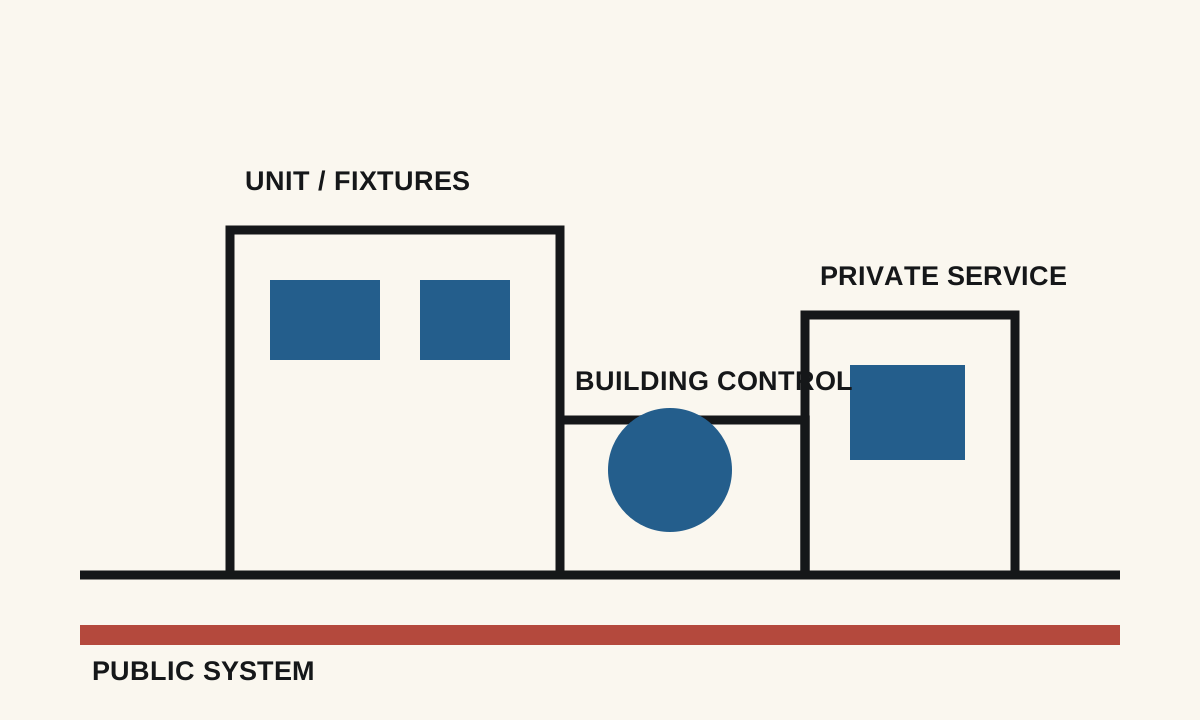
In Beacon Hill's condo buildings, the shared sewer stack — the vertical drain pipe that collects waste from all units and carries it to the building's lateral connection to the city sewer — is almost universally classified as common element infrastructure under the condominium master deed and trust documents. This means it is the collective responsibility of the condominium association, not any individual unit owner. When a section of the shared stack requires repair, the condo association is both the responsible party for authorizing the work and the party through whose building insurance the claim may be filed. In practice, this means that when you report a shared stack problem to us, we will work with you to notify your property manager or condo board, provide a written assessment and scope of work, and wait for the necessary board authorization before proceeding with major work. For genuine emergencies — active sewage backup or structural pipe failure — we will take immediate protective action to stop ongoing damage and then work on the authorization documentation in parallel. We understand that condo associations can sometimes move slowly on maintenance approvals, and we are experienced at providing the detailed documentation that boards need to act quickly when a plumbing situation genuinely warrants urgent attention. Our written scopes include clear photographs of the problem area, drainage camera footage when available, and a plain-language explanation of the consequences of delayed action — all of which helps condo boards make informed decisions promptly.
Beacon Hill is a designated local historic district under the jurisdiction of the Beacon Hill Architectural Commission, and many individual properties are also listed on the Massachusetts State Register of Historic Places or the National Register of Historic Places. While interior plumbing work — the vast majority of what we do — is generally not subject to historic commission review, any work that involves exterior alterations visible from the public way requires a certificate of appropriateness from the Beacon Hill Architectural Commission. This includes new utility penetrations through exterior masonry walls, vent pipe terminations visible from the street, and any modifications to the exterior building envelope for the purpose of routing new service lines. We have experience working within these regulatory frameworks and know how to design utility routing solutions that achieve modern plumbing performance — proper code-compliant venting, code-compliant gas appliance exhausting, proper water service sizing — while using penetration locations and cover treatment methods that satisfy historic commission requirements. For properties with particularly sensitive historic significance, we also consult with preservation-oriented contractors and architects who have specific expertise in Boston historic commission procedures. Our goal is never to treat the historic commission as an obstacle but to understand its requirements from the beginning and design our work accordingly, producing results that are both functionally excellent and historically appropriate.
The Boston Water and Sewer Commission (BWSC) is the public authority responsible for the water distribution and sewer collection infrastructure throughout the City of Boston. Unlike many Massachusetts communities where the Department of Public Works manages these systems, Boston has a standalone independent commission with its own permit office, inspection staff, tap fee schedule, and contractor registration system. Any plumbing work that involves connection to the city water main, modification of the curb stop valve, replacement of the water service pipe between the street main and the building, or any work on the sewer lateral between the building and the city sewer main requires BWSC review and permit issuance in addition to the standard Boston ISD building permit. For Beacon Hill specifically, the BWSC's infrastructure maps show a mix of older cast-iron water mains (some dating to the early 1900s) and newer ductile iron replacements, as well as brick-arched sewer collectors that run beneath several major Beacon Hill streets. Understanding the BWSC's infrastructure, permit process, fee schedule, inspector expectations, and inspection scheduling system is essential for any Boston plumber doing service work — and it is knowledge that takes years of active working experience in Boston to develop. We have completed hundreds of BWSC-permitted projects across Boston's urban neighborhoods and have established working relationships with BWSC permit staff and inspectors that help keep our projects moving efficiently through the approval process.
Lead in drinking water is a genuine and well-documented concern for Boston's older residential buildings, and Beacon Hill — with its extraordinary concentration of pre-1940 housing stock — is one of the Boston neighborhoods where this risk is most concentrated. Lead can enter drinking water from two primary sources within older buildings: the lead service pipe that connects the city water main to the building's internal plumbing system, and lead-soldered joints in the interior copper supply lines installed before the federal ban on lead solder in 1986. The Boston Water and Sewer Commission has published maps showing the approximate locations of known lead service pipes throughout the city, and a significant percentage of Beacon Hill addresses appear on those maps. The MWRA (Massachusetts Water Resources Authority), which supplies water to Boston, treats the water with orthophosphate to reduce lead leaching from pipe surfaces — but this treatment is only partially effective and does not eliminate lead exposure from severely corroded lead service pipes. The most effective solution is complete lead service pipe replacement, which removes the lead pipe from the water's path permanently. We offer full lead service pipe replacement under BWSC permit and can perform water quality testing to establish baseline lead levels before and after replacement. We can also install point-of-use or whole-house water filtration systems certified for lead reduction (NSF/ANSI Standard 53) as an interim or complementary measure. We strongly encourage all Beacon Hill residents in pre-1940 buildings to have their water tested and their service pipe material confirmed before assuming that lead exposure is not a concern.
From the gas-lit cobblestones of Acorn Street to the brownstones of Louisburg Square, we bring Massachusetts-licensed expertise to every Beacon Hill address we serve. Call now for immediate assistance.
Call (888) 861-3658 Now (888) 861-3658Available 24/7 • MA Licensed Plumber • Serving ZIP 02108 and all of Central Boston